Traditional Models Fall Behind Evolving Attacks
Attackers use AI to generate malicious code, phishing content, and automated attacks, accelerating threat creation and evolution beyond the response capabilities of traditional defenses.
AI-driven transformation has become a key trend in the cybersecurity industry. With high-performance AI networking solutions, Dilight helps cybersecurity enterprises unlock the full potential of AI and accelerated computing to build efficient, scalable security infrastructures and accelerate AI-driven innovation.
With the widespread adoption of LLMs, automated attack tools, and AIGC, cyberattacks are evolving from being “human-initiated” to “AI-assisted or even AI-driven”. Attackers can now launch attacks more rapidly, exploit a wider range of attack surfaces, and create a larger number of attack variants. Meanwhile, traditional security operations, which rely heavily on manual analysis and rule-based detection, are becoming increasingly difficult to handle the current scale and speed of cyberattacks.

Attackers use AI to generate malicious code, phishing content, and automated attacks, accelerating threat creation and evolution beyond the response capabilities of traditional defenses.
Growing volumes of network traffic, logs, and security events make manual analysis and rule-based filtering less effective, increasing operational costs and threat detection risks.
Signature-based and predefined rules are mainly designed for known attack scenarios, making it challenging to detect zero-day vulnerabilities, unknown threats, and AI-generated attack variants.
For cybersecurity enterprises, AI-driven development is not just about technological upgrades, but also about upgrading their business models. The differences between traditional cybersecurity and AI-Driven cybersecurity are as follows:
AI analyzes large volumes of traffic and logs in real time, helping lower MTTD and MTTR by reducing threat detection and response from hours or days to seconds.
AI automates log analysis, alert correlation, and incident prioritization, reducing manual workloads and alert fatigue for SOC teams.
As AI-driven attacks evolve, cybersecurity is shifting from rule-based to model-driven defense, improving unknown threat detection and automated response.
Cybersecurity enterprises in different development stages need to follow distinct AI transformation paths, progressing from integrating off-the-shelf large models to private deployment, and finally building proprietary AI platforms.
There is no absolute superiority or inferiority among different deployment methods. The right choice hinges on a company’s development stage, business needs, as well as its requirements for data security and AI capabilities. For cybersecurity enterprises undergoing AI transformation, picking a deployment model aligned with their business traits enables a balanced tradeoff among cost, operational efficiency and long-term competitiveness.

Best Fit:
Enterprises looking to quickly validate AI capabilities and achieve AI implementation with relatively low costs, especially for general business scenarios and applications with flexible data compliance requirements.
Typical Applications:
Supporting rapid AI capability validation and deployment of AI-driven business applications.

Best Fit:
Enterprises requiring stronger data security, privacy compliance, and low-latency inference, especially in data-sensitive industries such as finance, government, healthcare, manufacturing, and cybersecurity.
Typical Applications:
Supporting AI capability upgrades while ensuring data security.

Best Fit:
Enterprises with extensive industry-specific data and long-term AI investment capabilities, aiming to build domain-specific models and core competitive advantages.
Typical Applications:
Enabling proprietary AI capabilities and intelligent product ecosystems.
Different AI transformation paths come with distinct infrastructure requirements. They differ greatly in required computing power, network bandwidth and system architecture. For this reason, AI infrastructure planning shall be designed alongside business objectives. This avoids business bottlenecks caused by insufficient resources, and unnecessary cost waste from over-investment.
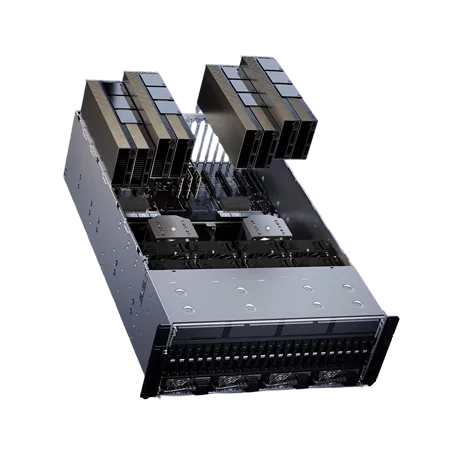
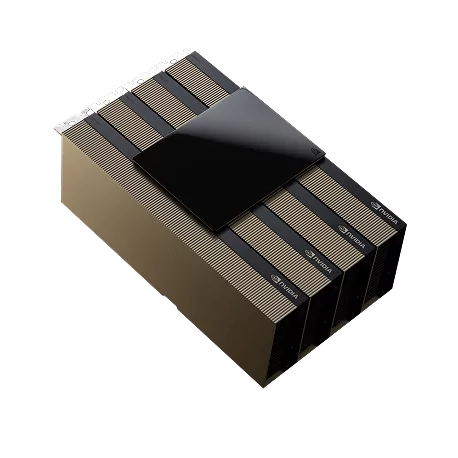
GPUs serve as the core component of AI infrastructure. Their performance directly determines model training efficiency, inference speed and system scalability. Below is an introduction to mainstream AI GPU models and their features, to support the selection of appropriate deployment solutions later on.

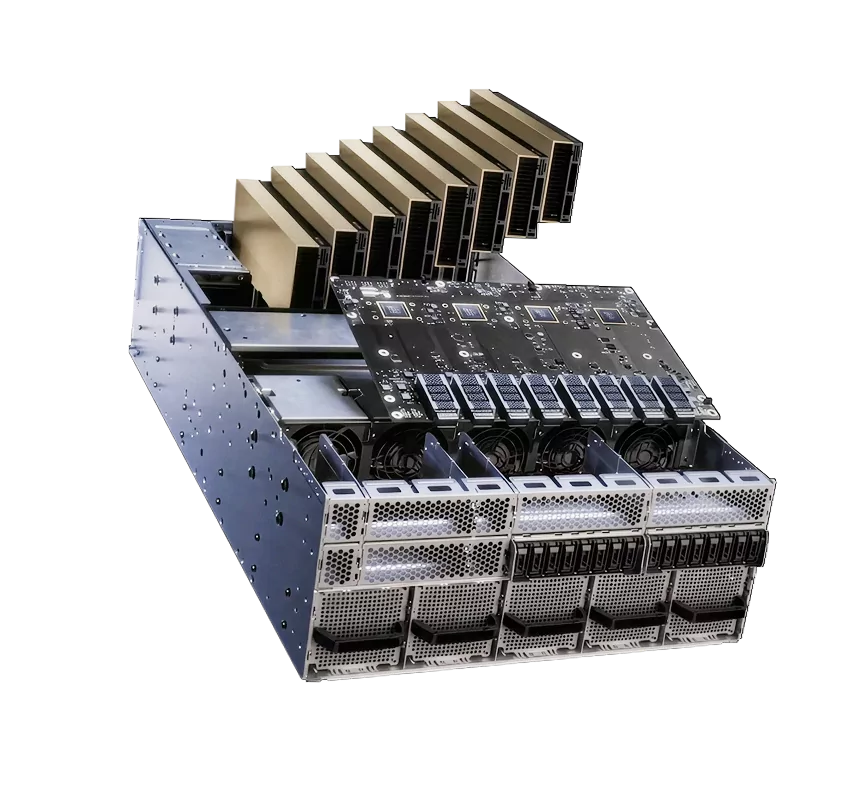
After understanding the positioning and capabilities of different GPU platforms, enterprises can select the computing platform that best matches their AI transformation approaches and business requirements. The following recommendations outline suitable GPU options for different deployment approaches:

| GPU Options | No self-built GPUs required | NVIDIA RTX PRO 4500/5000/6000 | NVIDIA H100 / H200 / B300 / GB300 |
|---|---|---|---|
| Selection Reasons | Model training and inference are provided by third-party service providers | Large memory capacity and high cost efficiency, suitable for deploying mainstream open-source models and continuous inference | Provides large-scale parallel computing capabilities, suitable for model training, fine-tuning, and complex Agent development, supporting long-term technology accumulation |
| Recommended Network |
|
After selecting the appropriate GPU servers, AI network architecture design generally follows a set of established principles. However, the implementation needs to be optimized based on factors such as cluster scale, training or inference workloads, and topology complexity. Detailed network design and topology configurations are beyond the scope of this section.
For customized network topologies, switch configurations, and overall interconnection solutions for clusters of different sizes, please contact the Dilight technical team. We provide end-to-end AI networking design and deployment support.
In Dilight's actual deployment solutions, customers use NVIDIA B300 GPU servers to build high-performance AI infrastructure based on self-developed training and large-scale AI agent scenarios, supporting large model training, continuous fine-tuning, and complex agent applications.
A cybersecurity enterprise is developing an LLM-based AI analytics platform that correlates security alerts, attack chains, and multi-source data for accurate threat detection and intelligent response. As model scale grows, existing compute and network architectures can no longer support large-scale training, requiring a lower-latency, higher-throughput infrastructure for real-time AI workloads.
System
NVIDIA B300 System
Compute Power
5000 PFLOPS(FP4)
Networking
800G InfiniBand XDR + 400G RoCE Networking
Not necessarily. For most cybersecurity enterprises, the priority should be to integrate existing products with LLM capabilities to build applications such as AI Copilots, intelligent assistants, and automated alert analysis, rather than investing directly in model training. Developing in-house training capabilities is recommended only when companies need to build industry-specific models or establish long-term core AI capabilities.
As a professional high-performance interconnect solutions provider and Top 8 optics manufacturer, we deliver full-stack solutions and products aligned with diverse architectures, ensuring architectural integrity, production-grade stability, and supply certainty.